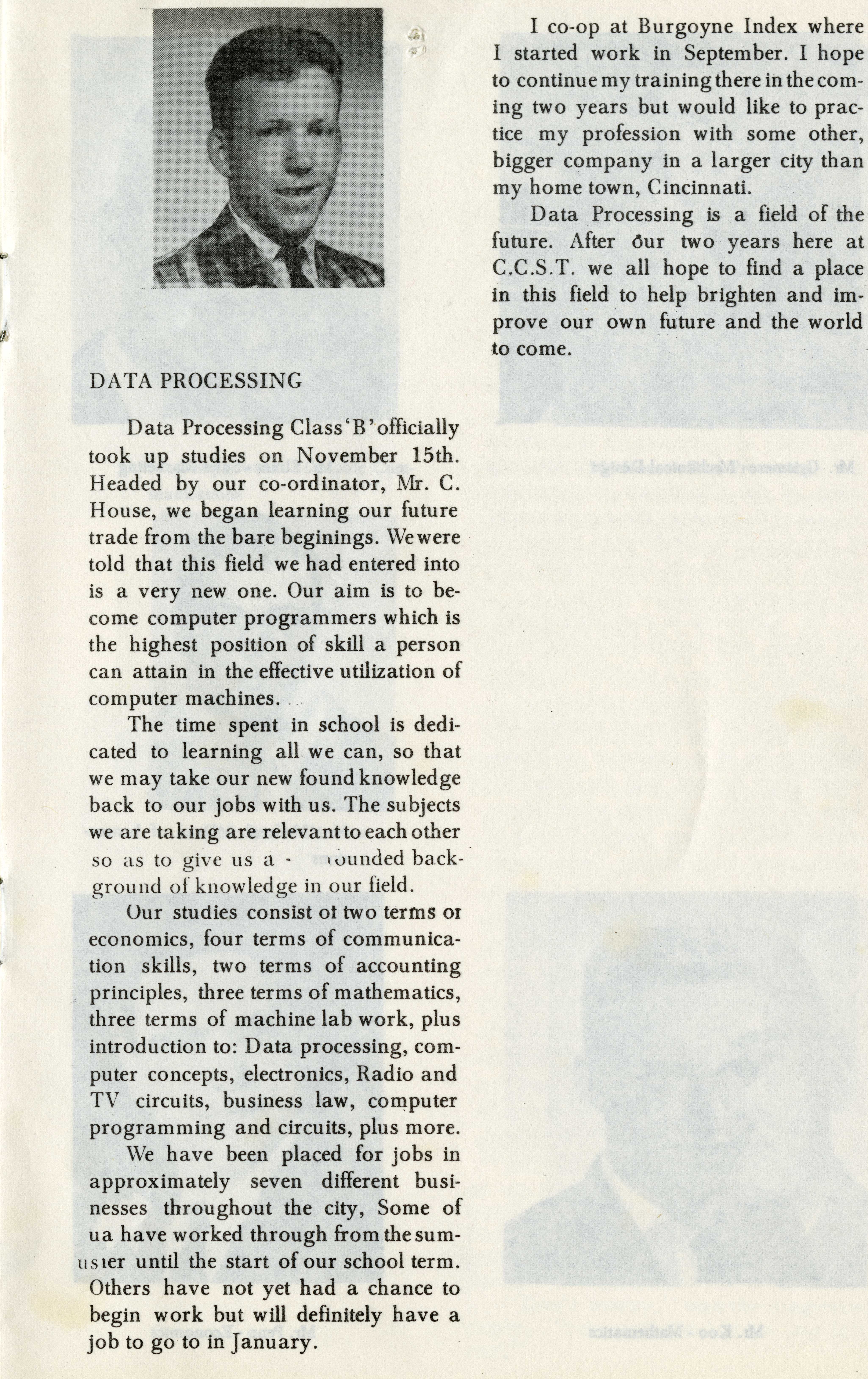
The future of computer machines, 1967

Unfortunately, the name of this young man was omitted from his article.  Perhaps he will stumble across this post about his post.

Posted in Department / Division, Press Releases / News articles | Tagged , , | Leave a comment

Beards, Mustaches and Sideburns, Oh My!


U2S6B03F01N007

Originally uploaded by Cincinnati State Archives

In the spirit of Friday, and inspired by the National Archives and their observance of Facial hair Friday, I am pleased to bring you (drum roll)…
These guys on the stairs! Classic facial hair, and other amazing treasures of history, can be discovered over at our flickr page. Maybe you fine folks out there on the internet can even help us identify some of our unknown photos. Have a great weekend!

Posted in Facial Hair Friday | Tagged , , , , | Leave a comment

This week in Cincinnati State history!

In 1994, 25 years after its founding, Cincinnati Technical College was approved to be a state community college.  This would make the college, renamed Cincinnati State, the first 2-year community college in Cincinnati.  According to the article, Cincinnati was the last large city in Ohio without a 2-year community college.  Cincinnati Enquirer

2-year colleges in the United States have been supplying the nation with educated, skilled workers for about 100 years.  The earliest junior colleges, as they were known, mostly educated women wanting to become teachers.  During the depression, they provided training in skilled trades and, after WWII, with the help of the GI Bill, afforded educational opportunities to those who had served their country.  The 1960’s and 70’s saw tremendous growth thanks to baby-boomers coming of age.  They have proven, decade after decade, to be especially vital in times of economic crisis in this country.

It is exciting to take part in preserving the long, rich history of community college education.

Posted in Trivia | Tagged , , | 1 Comment

Just for fun


U2S4B02F01N017

Originally uploaded by Cincinnati State Archives

In an effort to identify the people, places, events and, well, things in our terrific photographic collection, I will be periodically posting a flickr photo here for you to enjoy, ponder, or tag.

I thought this photo would be a good way to get started. The handsome folks in this photo need names, wouldn’t you say? Especially the one singled out by the arrow. He really stands out in the crowd.

Any science-y folks out there this morning who can identify what is happening in this microscope image?

Happy Tuesday!

Posted in Exhibits / Collections / Projects, Mystery Wednesday | Tagged , , | 2 Comments

Happy International Archives Day!

To celebrate, I thought I would post something international from our archives.

This page came from the November 1989 issue of the Cincinnati Technical College newspaper.

In area archives news:

While you are anxiously awaiting our next exhibit, take a look at the new online exhibit at the Lloyd Library: “In Search of Birds at the Lloyd.”

Posted in Holidays / Seasons / Events | Tagged , , | Leave a comment

Destination Cincinnati, by way of the USSR, 1980

Greetings!  Zdravstvuite!

I was going through our clippings file, looking for something else entirely, when I came across this interesting bit of Cincinnati State history.  In 1980, Cincinnati State (CTC at the time), in partnership with The Jewish Vocational Service, provided a technical education for Russian Jews immigrating to the United States in order to prepare them for new jobs.  A special class in data entry–transferring information to computer punch cards–was developed for the group of eleven women, at the end of which they would be qualified data-entry operators.

The women all left the Soviet Union because of Antisemitism and rampant shortages of basic necessities like food and clothing.  Many of them also left families and friends behind, as well as a familiar language and often professional jobs.  In spite of the frustration and hardship, the article reports, they “expressed great relief at being in this country”.

In 1980, Jews in Russia had only recently been permitted to emigrate.  Most visa applications, particularly those to Israel, were routinely denied.  Leonid Brezhnev, General Secretary from 1964-1982, tightened control by the state, ending the “liberalizing” policies of his predecessor, Nikita Khrushchev.  Under pressure from the West, Brezhnev permitted increased emigration through the 70’s and into the 80’s. To Illustrate: “In the years 1960-1970, only 4,000 people left the USSR; in the following decade, the number rose to 250,000.[46]

Until I stumbled upon this article I never knew Cincinnati State played a role in helping Russian emigrants adjust to life in the United States.  I don’t know about you, but I would like to learn more about this.

Posted in Archives in the News, Press Releases / News articles | Tagged , , , | 2 Comments

Access and the “Citizen Archivist”

I was just reading a recent blog post by David Ferriero, Archivist of the United States, about “cultivating citizen archivists“. In the post, Mr. Ferriero relates a story about a researcher who found a previously undiscovered Revolutionary War diary among records of the U.S Senate. I was struck by how a collection is never really “finished”. Even after the careful arrangement and description by the archivist, there still may be some undiscovered bit of archival gold, something that we may not realize the contextual value of until the researcher has brought it to our attention. We can’t even begin to imagine how significant even the most mundane-seeming records will become over time. Samuel Leavitt, the Revolutionary War Soldier keeping a diary on the front, probably didn’t know the value that his first-hand account would be to future scholars. While the researcher relies on us to provide access to historical records and artifacts by preserving, promoting, and collecting, we often depend on collaboration with the researcher to provide a depth of understanding to what we hold.

This got me thinking about how we are engaging our community in documenting the history of this institution. As I wrote last week, one way is promoting our collections through exhibits and via the internet. The Flickr page maintained by the archives is another way we can connect with potential “citizen archivists”. We invite people to visit the site and browse the photos. Many of them contain unidentified people, places and events. If you recognize something or someone, please let us know and we will amend the description. We are quite proud of our large collection of photographs dating from the inception of the college to the present.

There is an eager, collaborative spirit in our society that is quite powerful when tapped in to–just look at the success of Wikipedia and other forms of social media. Even the UK National Archives have a wiki where people can share their knowledge of archival sources and British history. The UK National Archives house 1,000 years of UK Government records. Try to imagine Cincinnati 1,000 years from now, or even 500 years from now. Then, try to imagine what sorts of treasures future researchers will unearth in our archives.

In other archives news, and speaking of future treasures: Last month, The Library of Congress acquired the entire Twitter archive! That’s right–all tweets since March 2006 are available to researchers through the LOC. Read the complete story here.

Tagged , , | Leave a comment

Greetings from the archives!

Hello friends.

My name is Natalie and I am pleased to bring you the inaugural post of the Cincinnati State Archives Blog.

Preservation Week just came to a close but here at the archives, every day is about preservation.  As part of the Preservation Week festivities, (yes, festivities–there was cake) I had the opportunity to tour the library and archives at Hebrew Union College.  They really have a spectacular collection and everyone should make a point to visit. Cincinnati has such a rich, fascinating history and we are but one of many local institutions preserving that memory.

The tour got me thinking about the many ways we preserve history.  There is the obvious– temperature and humidity control, storing records in acid free containers, keeping greasy fingers off the photos–but we also preserve by promoting our holdings.  This may seem counter-intuitive because by increasing awareness we possibly increase the number of greasy fingers but that is a chance we are willing to take.  By advocating for the collections we seek to ensure their existence in the future.  Institutions like ours have to justify themselves to funding sources, donors and other forms of support.  We must nurture partnerships with other institutions and pursue records to add to our collections.

One way we advocate for our collections is through exhibits, both physical and digital.  Currently we have an exhibit on display featuring the 40 year history of the Alumni Association at Cincinnati State.  Our next exhibit, one I am personally very excited about as it will be the first I contribute to, will feature the history of the Cooperative Education program here.  As you may be aware, co-op education began in 1906 at the University of Cincinnati and  Cincinnati State has played an integral role in co-op education since 1966.  Back then the college had to make 50 phone calls just to arrange the first co-op job and now has connections to over 800 employers.

The archives at Cincinnati State tell an important part of the story of Cincinnati.  We are excited to share that with you, and invite you to view our upcoming exhibits in person and on the web.

In other archives news:  After 80 years, the missing 25 minutes of Fritz Lang’s ‘Metropolis’ have been recovered from an Argentine archive and restored to the film.  Read the full story here.

And for more information about preservation week, and how you can protect your own treasures, visit: http://www.atyourlibrary.org/passiton
Posted in Archives in the News | Tagged , | Leave a comment